
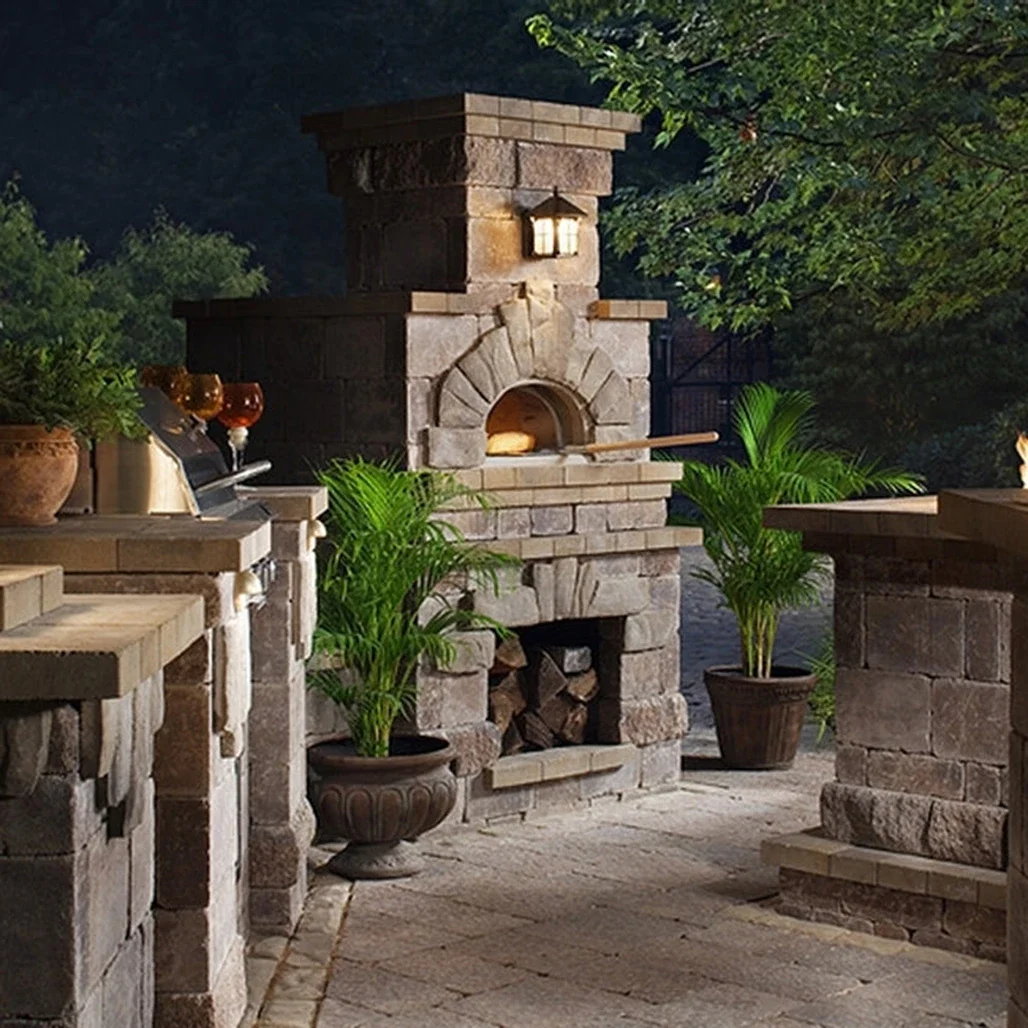
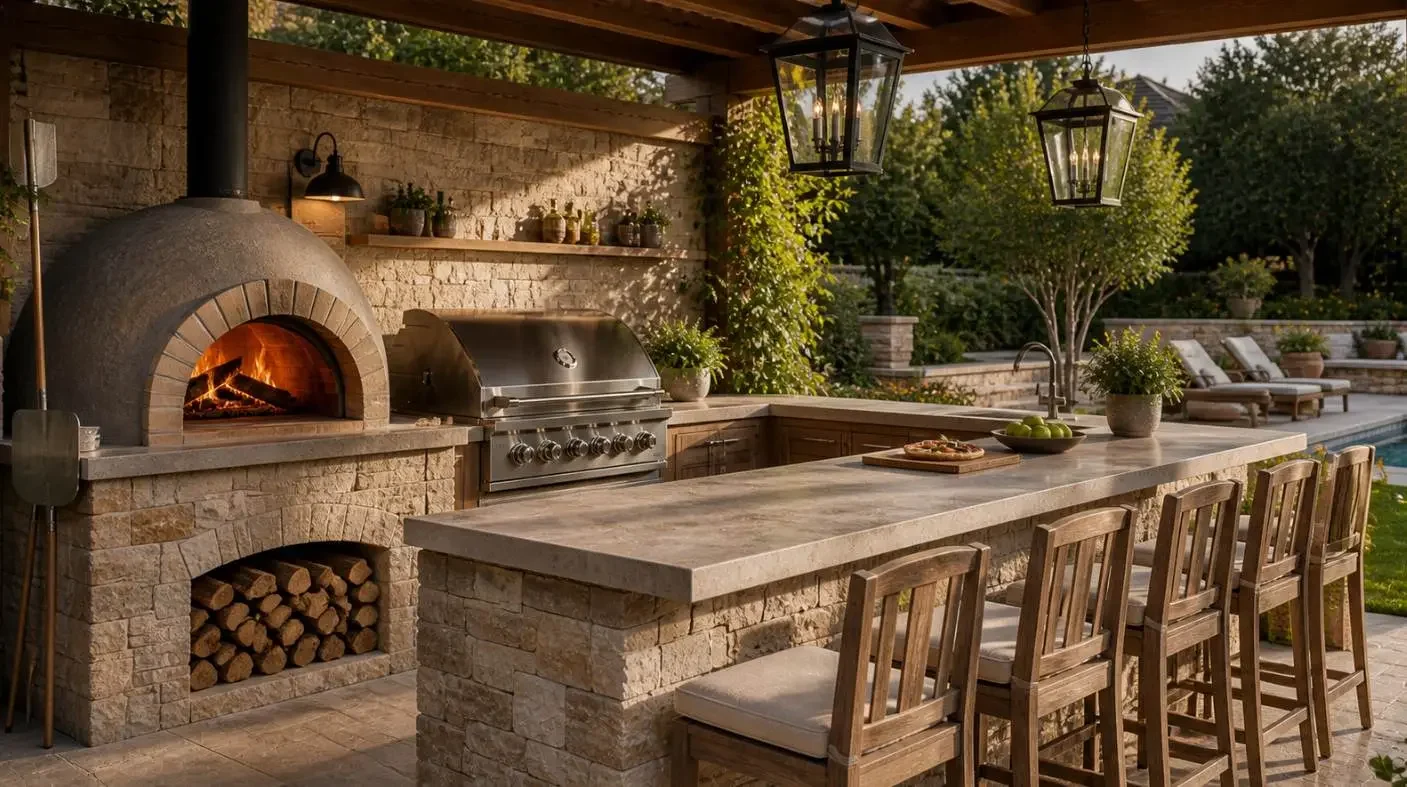
Key Takeaways
A masonry wood-fired oven can cook a pizza in roughly 90 seconds and continue to hold useful heat for hours afterward, for roasts and even bread the next morning.
Placement decides everything: wind, smoke, clearances, and the relationship to the table.
The best outdoor kitchens face the guests, so the cook stays part of the party.
Herb terraces and raised planters within arm's reach of the kitchen turn the yard into a working pantry.
Chef-oriented outdoor kitchens typically represent an investment of $75,000 to $150,000 as part of a full backyard, depending on scope.
There is a sound a wood-fired oven makes in the first moments after a pizza goes in. A soft roar. A pop of flame. And then, a minute or so later, the pizza comes out blistered and fragrant, leopard-spotted with char, cooked in roughly ninety seconds at temperatures that no kitchen oven can match.
Around the oven, twelve people are laughing. Someone is tearing basil straight from a stone planter three steps away. The cook, glowing from the heat and the company, has not left the conversation once.
This is what we mean by the chef's yard. It is not simply an outdoor kitchen. It is a place where cooking becomes the center of the evening instead of the reason someone misses it.
The Oven as Architecture
A masonry wood-fired oven is one of the oldest and most beautiful structures in cooking, and one of the most satisfying to build.
At its heart is a dome, constructed of refractory firebrick and mortar rated for extreme heat, which absorbs and holds enormous thermal energy. Around that dome sits insulation, and around the insulation, an outer surround of stone or brick that ties the oven into the character of the home. The interior is engineered for heat. The exterior is designed to be admired.
That thermal mass is the oven's secret. Fired properly, a masonry oven reaches temperatures in the range of 800 to 900 degrees for pizza, and holds heat for hours as the fire dies down. It cooks flatbreads in a minute or two. Later in the evening, it roasts vegetables and meats at gentler temperatures. The next morning, it may still be warm enough to bake bread. One fire, an entire day of cooking.
Placement Is Everything
Where an oven goes matters as much as how it is built.
A wood-fired oven produces smoke, so we study prevailing wind, the position of the seating and dining areas, neighboring properties, and the roofline of the home. We keep proper clearances from structures and combustible materials, and we design flues and surrounds accordingly. We also consider the daily experience: the oven should be close enough to the kitchen that moving between them is effortless, and positioned so that guests can watch the fire without sitting in the smoke.
In Newport Beach and Laguna Beach, where lots are often compact and neighbors close, this planning becomes especially important. Done well, an oven adds beauty and aroma to the whole evening. Done carelessly, it becomes a nuisance. We plan it as part of the entire yard, never as a stand-alone feature.
The Kitchen Around the Fire
An oven is at its best inside a well-planned kitchen. We think in terms of a working triangle: the oven, the grill, and the prep area, all within a few easy steps of each other. Add refrigeration, a sink, storage for tools and ingredients, and generous counter space on either side of the oven for staging.
Just as important is orientation. The best outdoor kitchens face the guests. An island or a counter with an open front puts the cook in the conversation instead of turned away from it. Guests can sit at a raised bar, watch the fire, and talk with whoever is cooking. The kitchen becomes the gravitational center of the gathering, and the cook becomes its host.
Countertop material is its own decision. If you are weighing options, our guides to granite slab, porcelain slab, and polished poured-in-place concrete walk through each.
Herb Terraces: The Living Pantry
The best kitchens in the world keep their ingredients close, and the chef's yard is no different.
We build raised stone planters within arm's reach of the kitchen, at a comfortable working height, filled with rosemary, thyme, oregano, sage, basil, and mint. Citrus, which grows beautifully in Orange County, can anchor a corner in a large planter or a dedicated bed: lemons for the evening's cocktails, limes for the fish, a tree that scents the entire terrace when it blooms.
The planters are designed for the job. They drain properly, they are lined and constructed to last, and they are tied into a simple drip irrigation system so the herbs thrive without daily attention. Wherever possible, the planting is placed to serve two purposes: feeding the kitchen and framing the view.
The effect is subtle, and unforgettable. Guests brush past rosemary on their way to the table. The cook steps away from the fire for a handful of basil. The yard smells like dinner before dinner begins.
The Cook at the Party
A common flaw in outdoor kitchens is isolation. A grill against a fence, a counter facing a wall, a cook turned away from everyone he is trying to feed.
We design the opposite. The kitchen sits at the heart of the yard, at the edge of the dining terrace, with clear sight lines to the table and the fire. Seating at the counter invites guests in. Lighting warms the work surface without glaring across the terrace. The oven's glow becomes part of the evening's atmosphere.
For families in San Clemente and Dana Point who cook together, this layout changes the way the whole household spends time outside. Cooking stops being a chore in the background and becomes the reason to gather.
Built to Take the Heat
Fire, weight, weather, and years of daily use put serious demands on an outdoor kitchen. The oven dome requires proper refractory materials and expansion detailing. The supporting structure has to carry the substantial mass of the oven. Counters must be engineered to bear weight and shed water. Every surface has to withstand the sun, the seasons, and the grease and spills of real cooking.
That means correct footings, quality masonry, careful joint work, and materials selected for the job instead of the catalog. It is the kind of craftsmanship that does not show on opening night and matters enormously ten years later.
From the crew: Our masons treat a wood-fired oven the way a bootmaker treats a good pair of boots: it is meant to be broken in and used hard. We build the dome so it can take a lifetime of fires, and the outside so it looks better every year it is lit.
How It Ages
A masonry oven is one of the few things in the yard that improves visibly with use. The dome darkens and seasons. The stone surround takes on a warm, lived-in patina. The herbs fill out and spill over the edges of their planters. After a few years, the whole kitchen looks as though it belongs to the property, as if it had always been there.
We stand behind our work in writing, because an oven built to last generations should come with a promise to match.
The Investment
A chef-oriented outdoor kitchen, including a masonry oven, prep and serving counters, herb terraces, and the supporting terrace and lighting, typically represents an investment of $75,000 to $150,000 as part of a complete backyard, depending on scope, materials, and site conditions. Every project begins with a design consultation and full-color rendering, so you can picture the evening before we build it.
Begin the Conversation
If you cook for the people you love, we would like to design the place where you do it. Schedule a design consultation at westhillsmasonry.com/contact or call us at 714-519-5009.