
What a Custom Backyard Transformation Costs in Orange County, and What Shapes the Investment
Key Takeaways
Complete custom backyard transformations from West Hills Masonry typically represent an investment of $250,000 to $500,000. Signature projects with extensive terracing, multiple structures, or custom stone work can extend beyond that.
Six factors shape where a project lands: scope, site conditions, materials, structures and features, design complexity, and utilities and lighting.
The most expensive parts of a project are often the ones you never see: structure, drainage, and base preparation.
Design typically takes 4 to 12 weeks and carries its own fee of $7,500 to $15,000, depending on lot size and HOA requirements.
The question worth asking is not "what does it cost?" but "what will it be worth to live in, and will it still be right in twenty years?"
Sooner or later, in almost every first conversation, a homeowner asks, "Am I in the right ballpark?"
It is a fair question, and one we think deserves a straight answer. The ballpark for a complete custom backyard transformation with us is typically $250,000 to $500,000. Signature projects with extensive terracing, several structures, or significant custom stone work can extend beyond that. Focused projects, such as a single feature, will land below it.
That answer is only useful if you understand what sits inside it. The same word, "backyard," covers a modest terrace and a hillside estate. So here is what shapes the number, and what you are really buying.
The Six Things That Shape the Investment
1. Scope. How many spaces are we building? A single terrace with a fire feature is a different project than a terrace, a dining area, an outdoor kitchen, a fireplace lounge, and stairs connecting three levels. Scope is the largest factor, and the one you control most.
2. Site conditions. Slope, soil, drainage, access, and existing structures decide how much work sits below the surface. A flat lot in Irvine with easy access behaves very differently from a hillside property in Dana Point or San Juan Capistrano, where walls, grading, and drainage carry much of the project. Tight access for equipment and materials adds labor as well.
3. Materials. Natural stone, porcelain, travertine, pavers, poured concrete, and stone veneer each have different costs, and different lives. Material choice is also a design choice, and it deserves to be made on how a surface will look and feel in ten years, not only on day one.
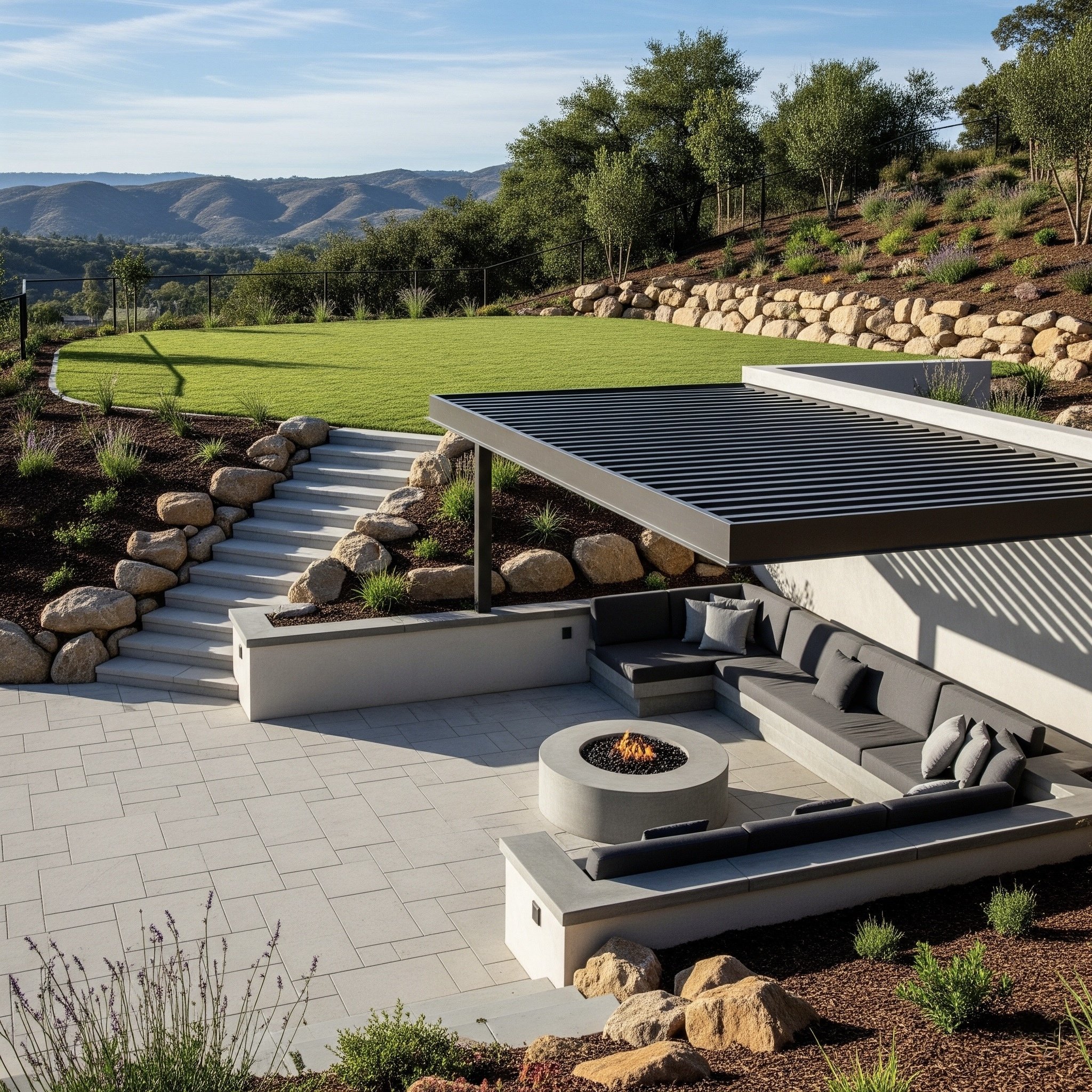
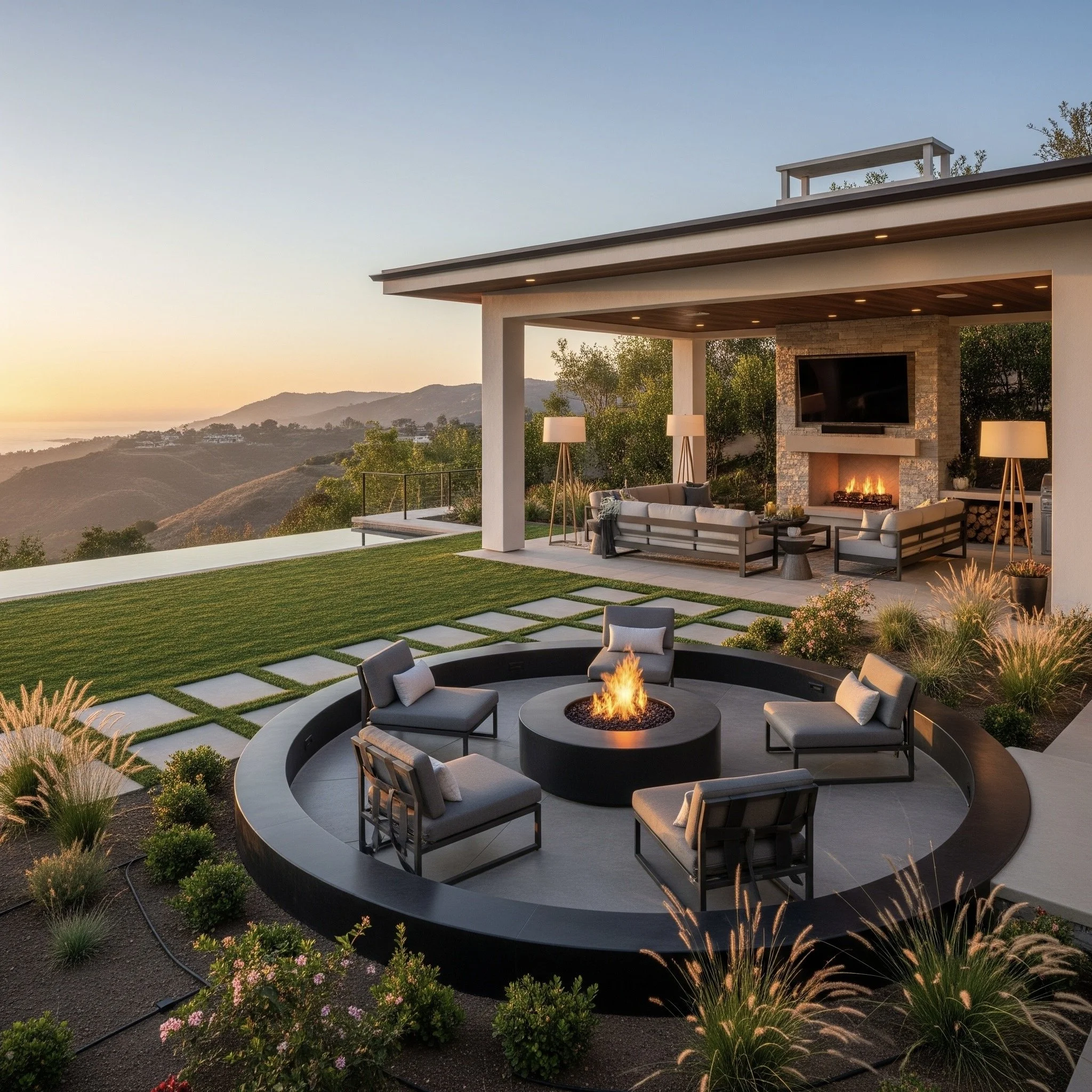
4. Structures and features. Fireplaces, fire pits, water features, pergolas, outdoor kitchens, and seating walls are built, not installed. Each is a small construction project of its own, with footings, framing, masonry, finishes, and often utilities.
5. Design complexity. Curves, custom detailing, multiple materials, and the level of finish all shape both design time and construction time. So does the presence of an HOA, which adds review, revisions, and care.
6. Utilities and lighting. Gas, electrical, water, drainage, and low-voltage lighting are unglamorous and essential. Done during construction, they cost far less and look far better than done afterward.
What You Are Really Investing In
A backyard proposal can look like a list of features. In practice, you are investing in five things.
Design. A plan that makes the whole yard work together, so that every decision is made once, on paper, where changes are inexpensive.
Structure. The engineered work beneath and inside the yard: footings, walls, drainage, and prepared bases. This is where a yard earns its longevity, and it is the part of the project that never appears in a photograph.
Materials. Stone, pavers, and finishes selected to suit the home, the climate, and the way you live.
Craft. The hands that set the stone: true lines, tight joints, clean edges, and details finished properly.
Assurance. A written warranty from the company that built it, and a team that answers the phone in year five.
Why the Lowest Number Is Rarely the Lowest Cost
Two proposals for the same yard can differ by tens of thousands of dollars, and the difference is rarely in the stone. It is in the base preparation, the drainage, the engineering, the level of finish, and the assumptions about what happens when the crew meets a surprise.
We do not say this to argue that higher is better. We say it because the failures homeowners tell us about, sinking pavers, cracked walls, pooling water, all begin below the surface, in places a proposal does not photograph. Ask what is under the surface. It is the most useful question in the entire process. (For a fuller look at where things go wrong, see our guide to 5 costly hardscape remodel mistakes, and for the mechanics of pricing, what actually moves the needle on pricing.)
How the Process Works, and What Design Costs
We begin with a phone call. You send photos of your yard, inspiration images or products you love, and the styles you are drawn to. From there, we move to a design agreement, and once it is signed, we visit the property to review conditions and take measurements. Then we prepare the first design pass.
Design fees typically range from $7,500 to $15,000, depending on lot size and whether strict HOA requirements apply, and the design phase usually takes 4 to 12 weeks. That may sound like a long time before a shovel touches the ground. It is where the money is protected. Every decision made in design is a decision that does not have to be made, and paid for, on site.
Timing and Planning
Design can begin at any time of year, and fall and winter are an excellent time to start, for reasons we explain in why winter is the best-kept secret for starting a big project. For yards with slopes or drainage concerns, thoughtful timing also helps the site prepare before heavy weather.
If the full vision exceeds what you want to invest at once, a phased plan can spread the work over time without compromising the whole. We explain how that works in a later post.
The Work Below the Surface
From the crew: The part of a job that takes the most time, and gets the least attention, is usually the part in the ground: excavation, compaction, base, drainage. The goal is a yard where you never have to think about what we did down there: the water goes where it should, nothing moves, and the stone looks the same in year ten as it did the day we cleaned up.
How It Ages
A backyard built well is an appreciating experience. The stone softens and warms. The planting fills in. The seating walls develop the patina of a well-used room. The investment reads better every year, in comfort, in beauty, and in the way the home and yard begin to feel like one place.
We stand behind the work with a written warranty, because a yard meant to last decades should come with a promise to match.
The Investment, Summarized
Complete custom backyard transformations: typically $250,000 to $500,000. Signature projects can extend beyond that range.
Design fee: typically $7,500 to $15,000, depending on lot size and HOA requirements.
Design timeline: typically 4 to 12 weeks.
Focused projects, such as a single feature, land below the complete-backyard range, and are quoted after design.
Begin the Conversation
If you would like to know where your own project might land, the conversation begins with a call. Schedule a consultation at westhillsmasonry.com/contact or call us at 714-519-5009.