
Why San Clemente Backyards Are Built Differently
Key Takeaways:
• Salt air accelerates corrosion in metal fasteners, hardware, and lighting fixtures far faster than inland Orange County
• Marine layer keeps certain areas of a yard shaded and damp well into the afternoon, changing which materials and sealers will hold up
• Bluff and hillside lots often require different drainage engineering than flat inland lots
• Coastal setback and grading rules can shape a design before a single stone is chosen
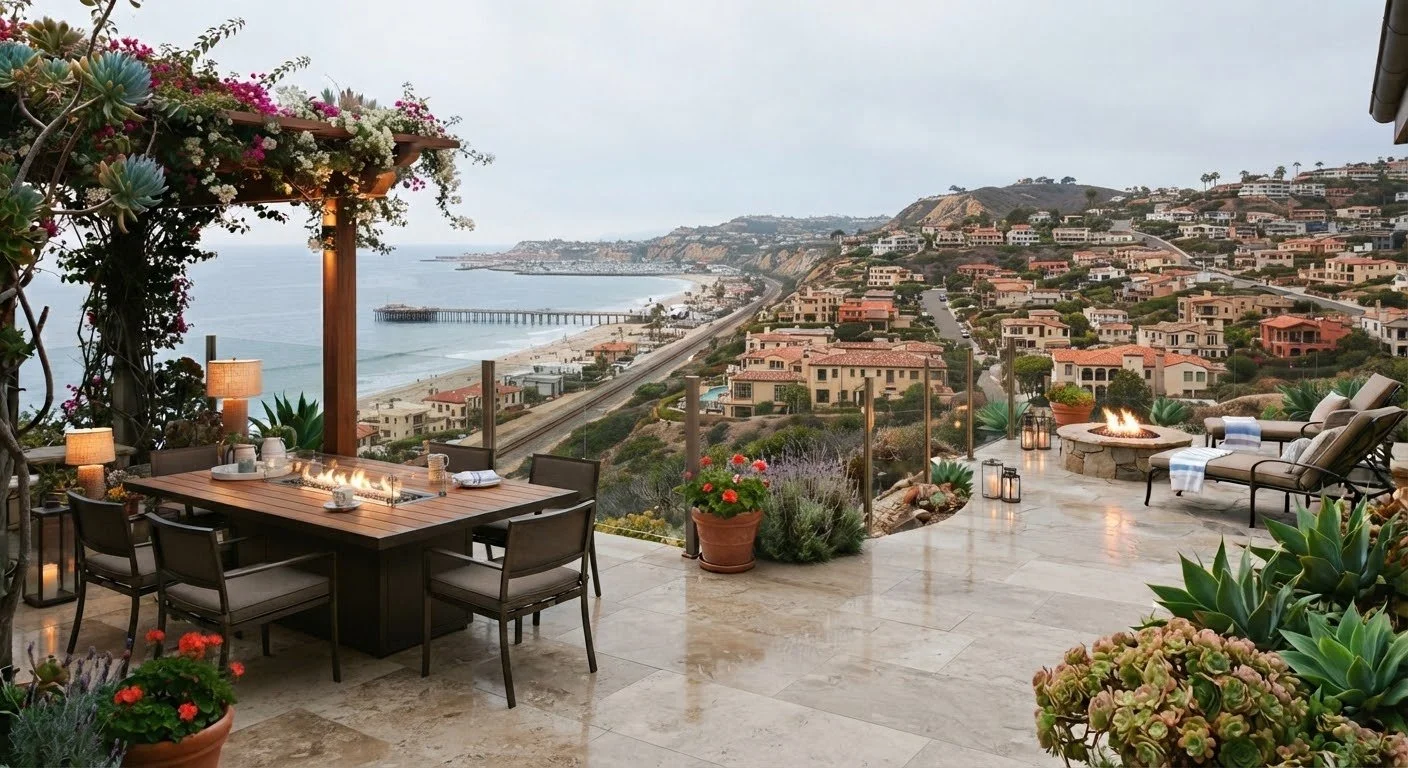
San Clemente doesn’t behave like the rest of Orange County, and if you’ve lived here more than a season, you already know it. The marine layer rolls in most mornings and sometimes doesn’t lift until noon. The air carries salt. The hillsides drop toward the ocean at angles that flat inland lots never have to reckon with. A backyard here isn’t just landscaping with an ocean view bolted on it’s a different set of engineering problems wearing a beautiful disguise.
We’ve built enough patios, walls, and outdoor living spaces along this stretch of coast to know where homeowners get surprised, usually a year or two after a project that wasn’t built with San Clemente’s climate in mind.
The Marine Layer Problem Nobody Designs For
Most people planning a backyard think about sun. In San Clemente, you also have to think about the absence of it. Areas of a yard that face the coastline can stay shaded and damp well past the hours you’d expect, especially in late spring and early summer when the marine layer is thickest. That moisture doesn’t evaporate quickly. It sits.
For hardscaping, this matters more than most homeowners realize. Certain paver sealers perform beautifully in dry, sun-baked inland yards and struggle in a space that stays damp until 11am most mornings. Natural stone with higher porosity can hold moisture longer than it should, which over years can affect both appearance and structural integrity at grout lines and joints. We select materials and sealing schedules differently for a coastal-facing patio than we would three miles inland, because the two spaces are living in different microclimates even though they’re in the same city.
Salt Air and the Slow Corrosion Nobody Notices Until It’s Done
Salt air is patient. It doesn’t announce itself the way a cracked slab does. It works quietly on anything metal rebar embedded too close to a surface, uncoated fasteners, lighting fixtures, hinges on gates and outdoor kitchen doors. In coastal Newport Beach and San Clemente alike, we’ve seen otherwise well-built structures develop rust staining and hardware failure years before an inland equivalent would show any wear at all.
The fix isn’t complicated, but it has to be intentional. Marine-grade or coated hardware, proper concrete cover over any embedded steel, and material choices that account for salt exposure from day one. This is the kind of decision that’s invisible in a finished photo and very visible in a homeowner’s maintenance bill five years later if it’s skipped.
Building on a Bluff Changes the Drainage Math Entirely
A meaningful number of San Clemente properties sit on sloped or bluff-adjacent lots, and slope changes how water has to be managed. On a flat inland lot, drainage is often a matter of pitch and a single collection point. On a hillside lot, water wants to move fast, and if it isn’t given a deliberate, engineered path, it will find its own usually along a retaining wall’s backfill, or against a foundation it was never supposed to touch.
We design retaining walls along this coastline with drainage as the starting point, not an afterthought: proper backfill material, weep systems, and in some cases sub-surface drains that route water away from both the wall and the home above it. On these lots, the wall isn’t just holding back soil. It’s managing a hydrology problem that inland Coto de Caza or Ladera Ranch projects simply don’t face in the same way.
Working Within the Coastal Setbacks
San Clemente’s proximity to the coast also means certain projects fall under coastal development review, which can influence everything from where a wall sits to how tall a structure is permitted to be. This isn’t a hurdle to complain about it’s part of building responsibly in a place this valuable. But it does mean a San Clemente project often needs its permitting and design sequence handled differently than a comparable job further inland in Laguna Hills or San Juan Capistrano.
What This Means If You’re Planning a Project Here
None of this is meant to make a San Clemente backyard sound complicated for its own sake. It’s meant to explain why a design and material approach that works beautifully in Dana Point or further inland doesn’t automatically transfer here without adjustment. The ocean gives this coastline something no inland lot can offer. It also asks for a little more care in return.
If you’re planning a project along this stretch of coast, or anywhere from Dana Point to San Juan Capistrano, it’s worth having a conversation before the design is finalized rather than after. Schedule a consultation at westhillsmasonry.com/contact or call (714) 519-5009.