What Your Driveway Says About Your House Before Anyone Rings the Doorbell
Key Takeaways
• A driveway is experienced before the front door, the landscaping, or the architecture, so it sets the expectation for everything that follows
• Pattern, border, and material choice change how wide and how intentional a driveway feels, independent of its actual square footage
• Grading and base work happen before any surface material is chosen, and they’re what determines whether the driveway still looks right in ten years
• A driveway designed alongside the front walkway and entry reads as one decision, not three unrelated ones
• The most common mistake is treating the driveway as the last line item in a project instead of the first thing a guest actually experiences
By the time a guest reaches your front door, they’ve already formed an opinion about your home. It happened somewhere between the street and the porch, and for most properties, the driveway is where that opinion actually gets made. It’s the largest single surface most visitors walk or drive across, and it’s usually the last thing anyone thinks to design on purpose.
We treat it differently. A driveway isn’t a slab you pour because a car needs somewhere to sit. It’s the opening sequence of the property, and it deserves the same amount of design thinking as the entry it leads to, whether that’s a single-story ranch in San Clemente or an estate lot in Newport Coast.
Pattern and border change how a driveway feels, not just how it looks
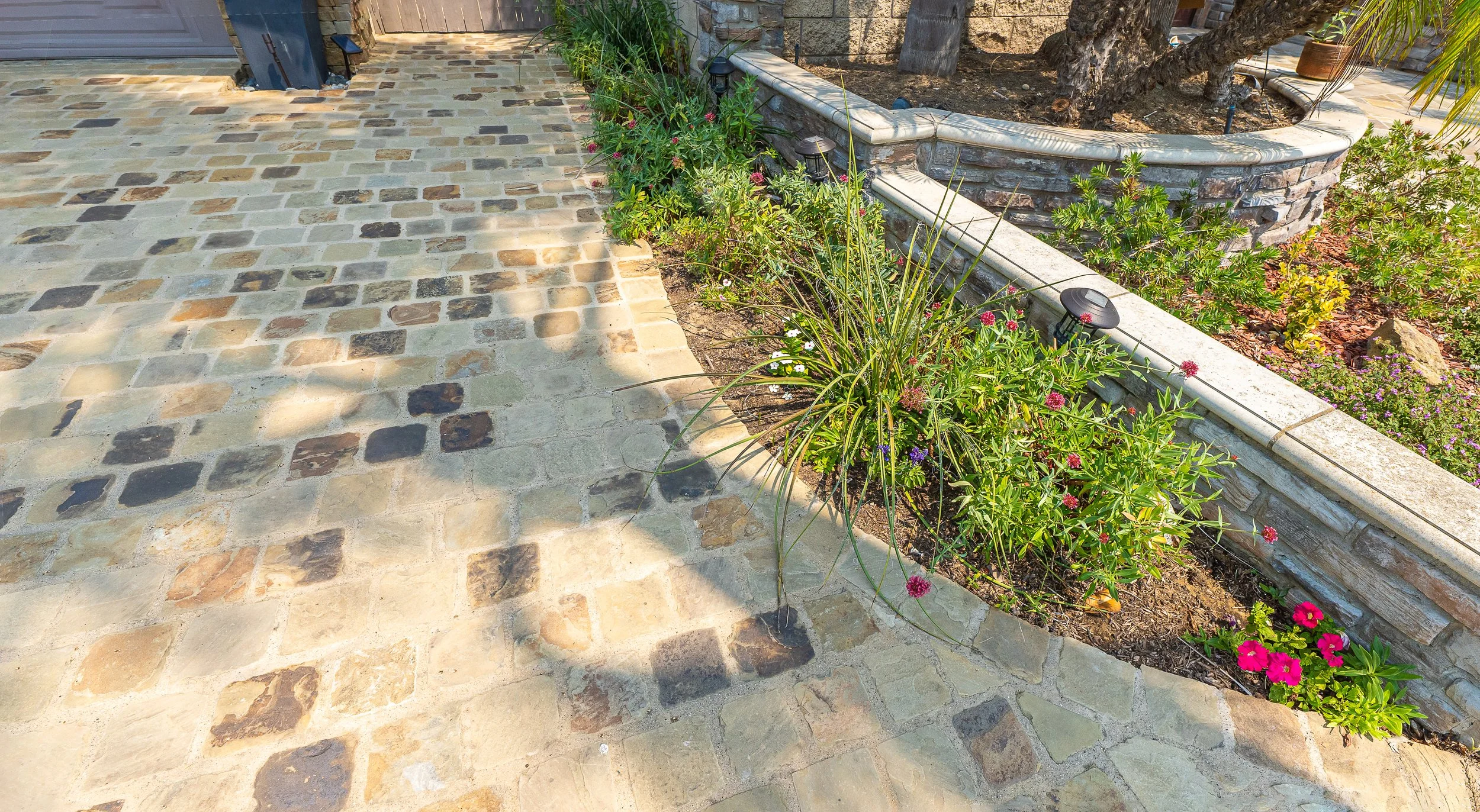
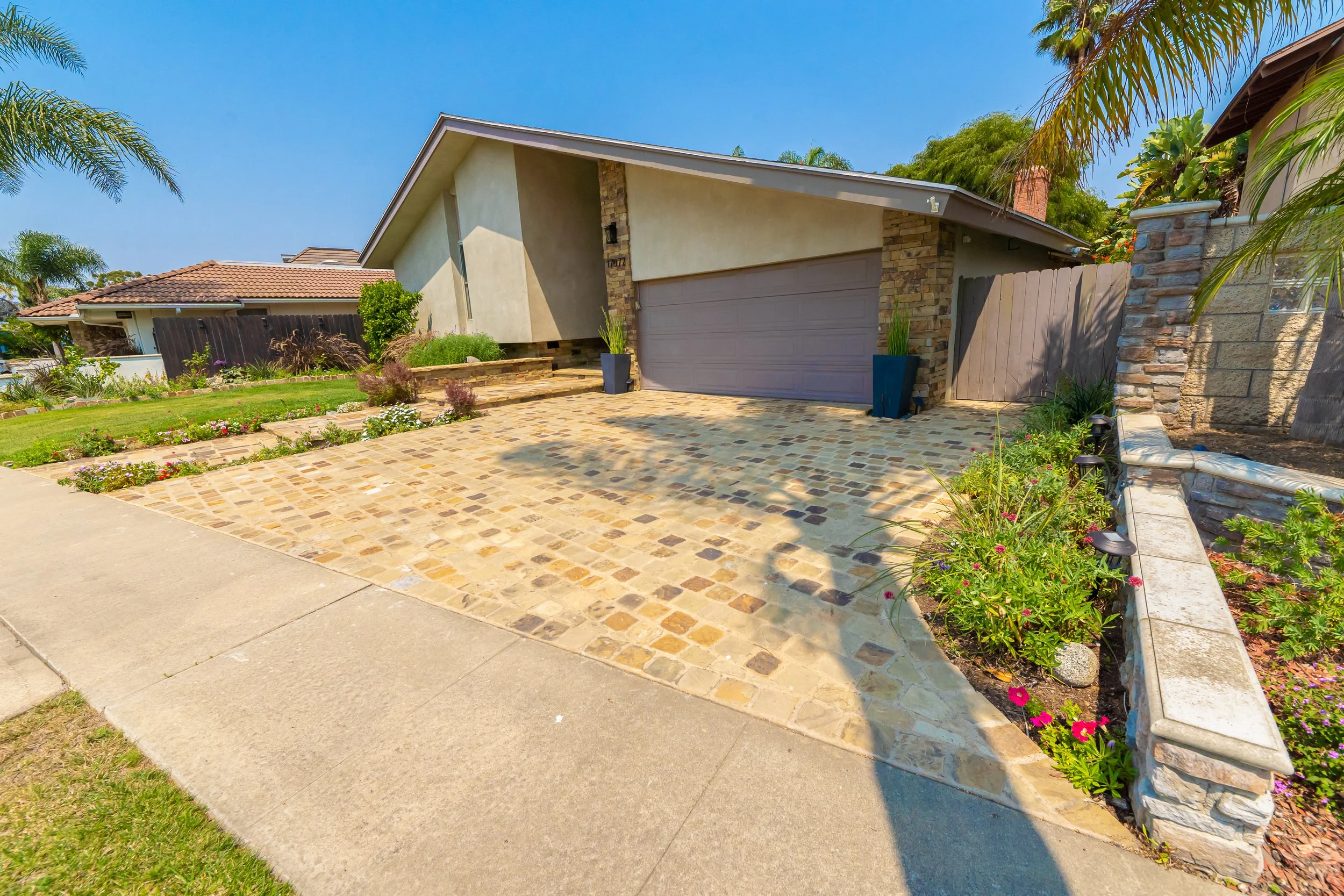
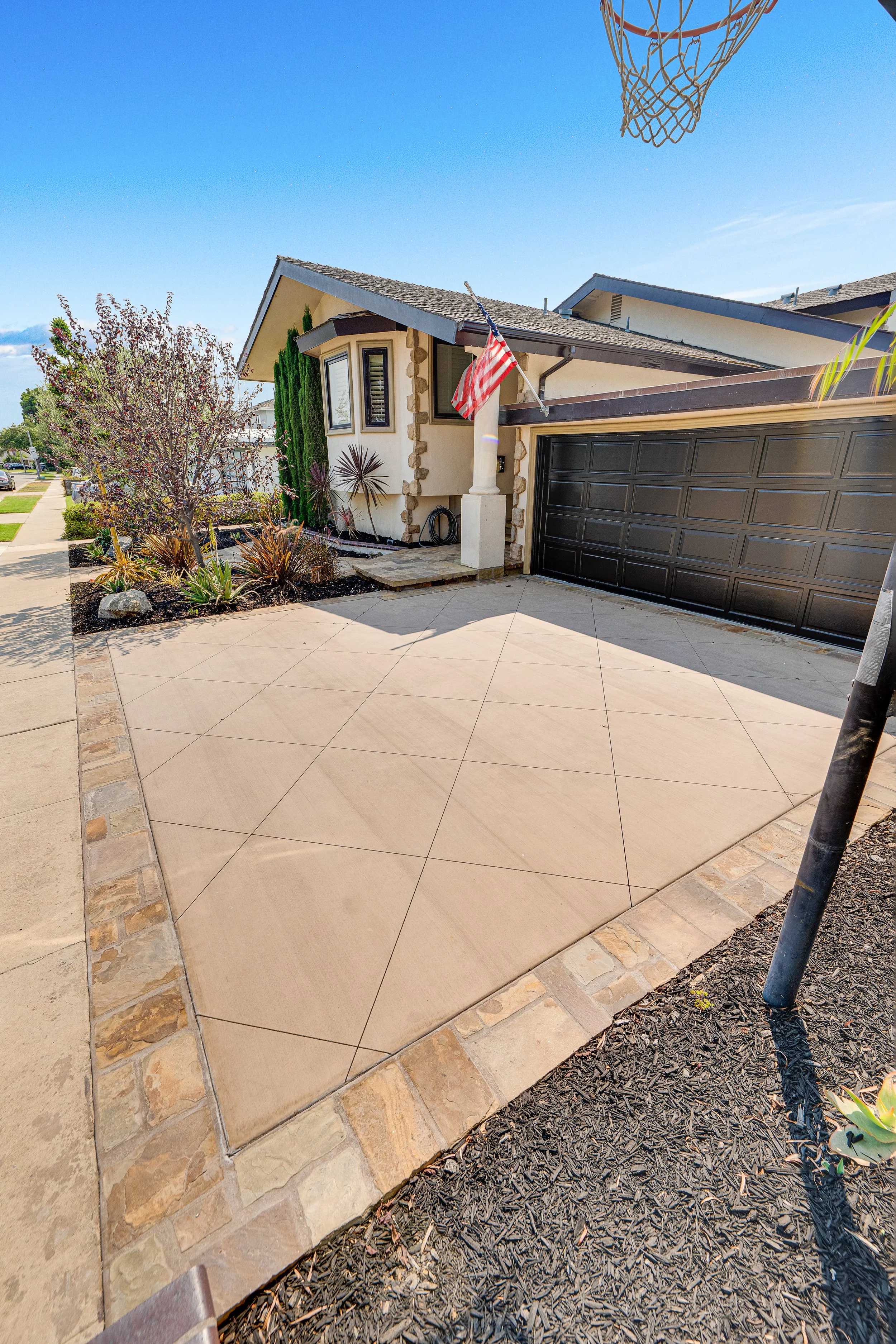
Two driveways can be the exact same square footage and feel completely different depending on the paver pattern and border treatment. A herringbone pattern reads as more formal and can make a driveway appear wider than it is. A running bond feels more relaxed and works well on a modern or transitional home. A contrasting border, even a narrow one, frames the whole surface and gives it an edge that a plain field of pavers or a single slab of concrete never will.
This is a decision we make early, alongside the overall design, not something we ask a client to pick off a sample board after the layout is already set.
What’s underneath matters more than what’s on top
The material you choose, whether it’s travertine, concrete pavers, or a stamped and colored slab, will only look as good as the base underneath it. Driveways carry more consistent load than almost any other hardscape surface on a property, and a base that isn’t properly excavated and compacted will show it within a few years, usually as cracking, settling, or drainage pooling in low spots.
We grade and compact before we ever discuss the surface material, because the surface is the easy part of this decision. The base is the part that decides whether the driveway still looks the way it did on installation day a decade from now, and that holds true whether the property is on flat ground in Newport Beach or a graded lot in Laguna Hills.
The driveway and the front walkway should feel like one decision
One of the more common mistakes we see on properties that have been renovated piecemeal over the years is a driveway and a front walkway that clearly came from two different projects, sometimes literally two different contractors, years apart. Different material, different color, a hard transition line where one ends and the other begins.
When we design a driveway, we’re thinking about how it hands off to the walkway, and how the walkway hands off to the entry. The goal is for a guest to experience one continuous, intentional path from the street to your front door, not three separate surfaces that happen to be adjacent to each other.
Motor courts and circular driveways solve a real problem, not just a look
For larger properties, a motor court or circular driveway isn’t purely aesthetic, it’s functional. It solves turning radius and guest parking in a way a straight driveway can’t, especially on properties that regularly host more than one or two vehicles at a time. But these layouts also require more lot depth and setback than most homeowners assume going in, which is part of why this is a conversation we have early in design rather than something we retrofit into an already-finalized plan. It’s a conversation that comes up often on the larger properties we work on in San Juan Capistrano and Dana Point.
Permeable pavers, when they’re worth it
Permeable paving has become a popular talking point, and it does solve a real problem on properties with drainage challenges or local requirements around stormwater runoff. But it’s not automatically the right choice for every driveway. We’ll walk you through when it actually earns its higher cost and maintenance requirements, and when a properly graded standard paver or concrete driveway will serve you just as well for a fraction of the complexity.
The first five seconds are worth designing on purpose
None of this is about spending more for the sake of it. It’s about recognizing that the driveway isn’t a placeholder on the way to the parts of the property people actually notice, it’s often the first part they notice. A driveway that’s designed with the same intention as the backyard behind it tells a visitor something true about the rest of the property before they’ve seen any of it.