
What the Ultra-High-End Client Is Actually Installing
Key Takeaways
• Estate-level clients no longer treat smart technology as an add-on; they treat it as a baseline expectation, planned in from day one alongside the hardscape itself.
• The four systems showing up most consistently: app-controlled RGBW landscape lighting, whole-property outdoor audio, Wi-Fi-enabled irrigation, and motorized louvered pergolas.
• What separates these installations from a typical retrofit is sequencing: the masonry, footings, and conduit paths are built to house the technology before it ever arrives on site.
• Motorized pergola structures alone often represent a $75,000 to $125,000 investment, and require engineered footings, not a standard patio-cover foundation.
• Homeowners in Newport Beach, Newport Coast, and Dana Point are asking for these systems as a matter of course, not as an upgrade conversation midway through a project.
Spend enough time on job sites in San Juan Capistrano, Newport Coast, and Dana Point, and a pattern becomes obvious. The clients building at the highest level aren’t asking whether to include smart technology in their outdoor spaces. They’re asking how it gets built in cleanly, permanently, and in a way that won’t need to be torn open again in five years. It’s no longer a lighting package added at the end of a project. It’s part of the design brief from the first meeting.
Four categories show up again and again on these properties.
Color-Changing, App-Controlled Landscape Lighting
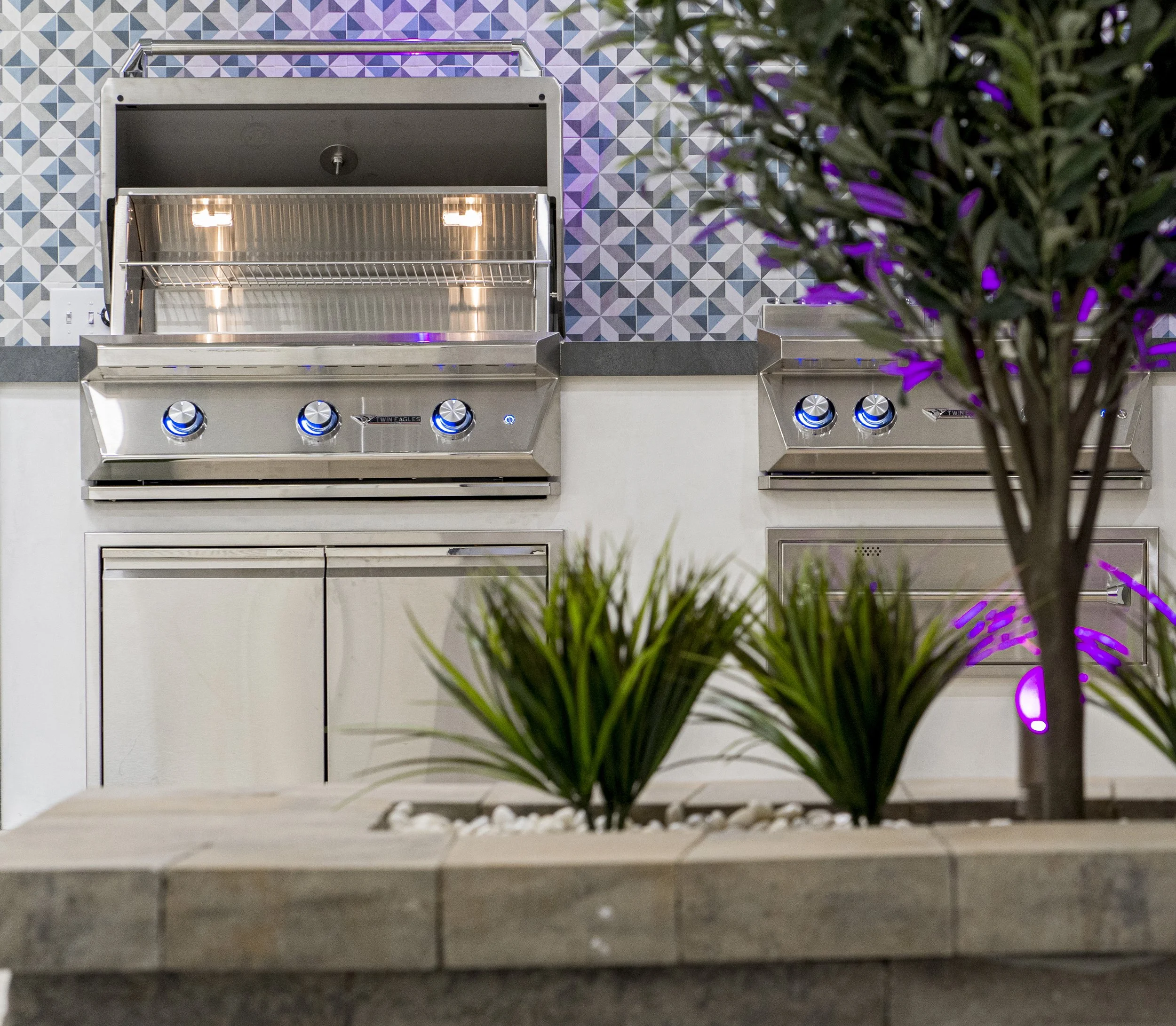
The days of a single warm-white uplight tucked at the base of a tree are largely gone at this level. What’s replacing them are RGBW systems built around a central transformer, capable of running an entire property on a coordinated palette, washing a stacked stone wall in white for a family dinner and shifting the same fixtures to color for a party an hour later, all from a phone. The clients installing these systems aren’t chasing novelty. They’re after control and consistency across a large property, which only works when the wiring and fixture housings are integrated into the hardscape rather than run along the surface of it.
Whole-Property Outdoor Audio
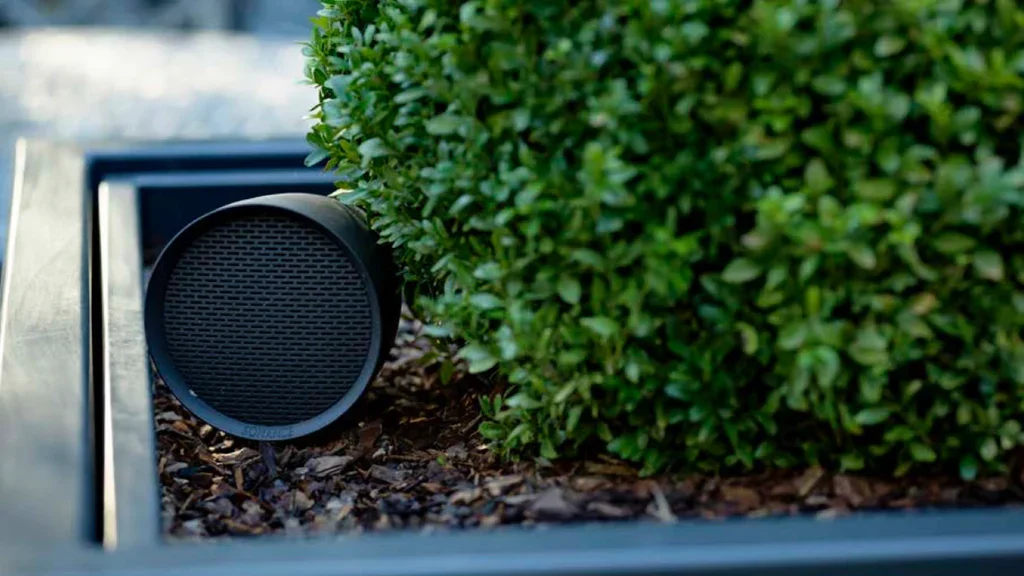
Outdoor audio has followed a similar arc, from a couple of weatherproof speakers under a covered patio to fully zoned systems that carry sound from the kitchen to the pool to a fire pit seating area on the far side of the yard. On the estate properties we’ve worked near Newport Beach, audio placement is decided at the same table as paver layout and planting beds, because speaker wire needs a path, and the cleanest path is the one built into a wall or paver base during construction, not one added afterward.
Wi-Fi Irrigation That’s Actually Used
It’s a small line item next to a six-figure hardscape budget, generally $150 to $400 for a smart controller and Wi-Fi module, but it’s one of the systems most likely to sit unused if the plumbing and conduit weren’t coordinated in advance. On the properties where it’s working the way it’s supposed to, valve placement and sleeve routing were part of the original grading and hardscape plan, not a decision made after the beds were already in.
Motorized Louvered Pergolas
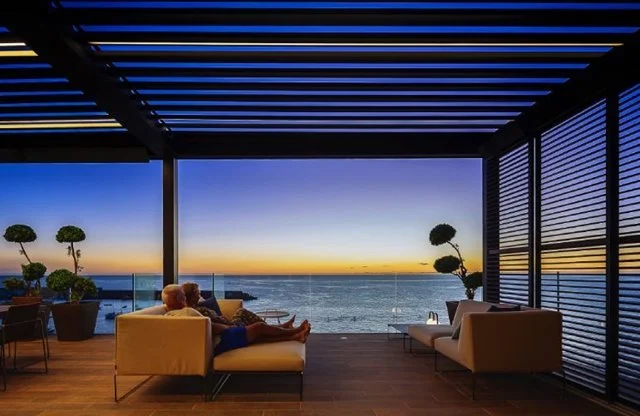
This is the largest single technology investment most high-end clients make outdoors, typically $75,000 to $125,000 depending on scale and features, and it’s also the one most dependent on what’s underneath it. A motorized louvered structure is heavy and wind-loaded. It needs a footing engineered for that specific unit, and we’ve seen the alternative: a pergola set on a footing designed for a lighter structure, cracking the surrounding pavers within two years. On a property in Laguna Hills, getting the structure right meant treating the footing with the same engineering rigor we’d give a retaining wall, because functionally, that’s what it is.
The Common Thread
None of these four systems is complicated on its own. What makes them work at the level ultra-high-end clients expect is sequence: the masonry and concrete are built to anticipate the technology, with conduit sleeves, transformer housings, and engineered footings in place before the lighting, audio, irrigation, or pergola contractor ever shows up. Retrofitting that same infrastructure into finished hardscape costs a multiple of building it in from the start, and it rarely disappears into the design the way it should.
We coordinate this planning with our landscape anrchitect and the relevant technology from the design phase forward, on projects ranging from a phased backyard upgrade in San Clemente to a full estate build in Dana Point. The goal is the same either way: by the time the smart technology arrives, the property is already built to hold it.